Barbed Wire Fence Installation in Topeka, KS
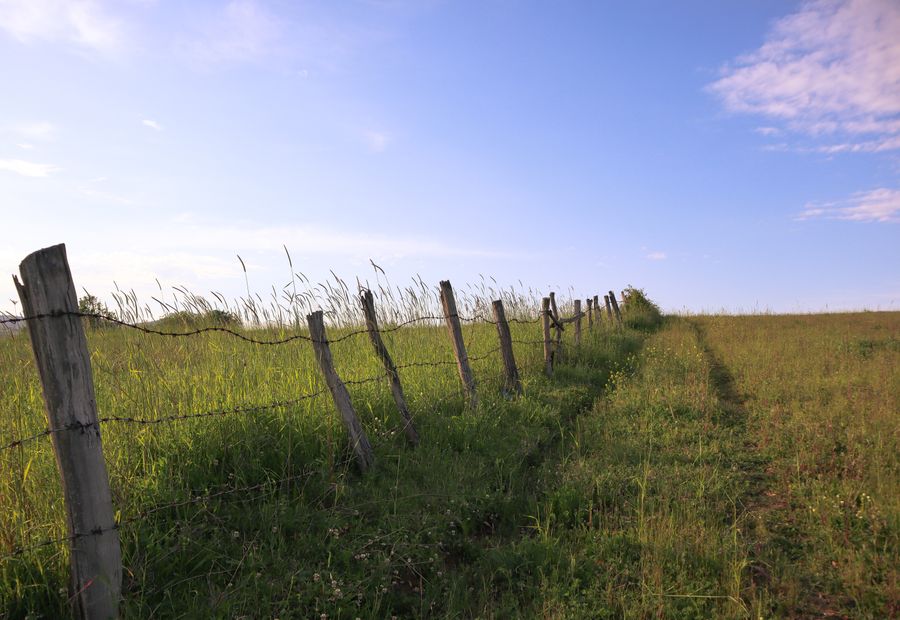
Topeka Farm Fence strings barbed wire pasture fence for cow-calf operations, hay ground, and boundary lines across Topeka and the farm country around it. Our crews work Shawnee, Osage, Jackson, Jefferson, and Wabaunsee counties, Kansas, from Tecumseh and Berryton out through Meriden, Hoyt, and the grass west of Alma.
Barbed wire is the cheapest cattle fence per foot, and it lives or dies on the corners. We set hedge or CCA ground contact treated corner posts six to eight inches across, three and a half to four feet in the ground, tamped in lifts, with a horizontal rail and a brace wire twisted tight on the diagonal. Line posts are driven steel T-posts at eight to twelve feet, or wood at twelve to sixteen. Wire is Red Brand or Bekaert Gaucho in Class 3 galvanizing, stretched with a come-along and a wire grip until the strand rings. A T-post corner with wire wrapped around it is the fence that leans over the first time forty cows lean on it, because a driven post holds wire up and cannot hold wire back.
Hedge Posts and Kansas Ground
Osage orange, called hedge here, was planted in living fence rows across Kansas in the eighteen hundreds, and the posts cut from those rows outlast steel in the ground. Hedge never gets treated and never rots at the ground line. We set it where a landowner has a stack of it cut and seasoned, which around Topeka is more often than you would think. Where there is no hedge, treated pine goes in deeper than the frost reaches, since clay here lifts a shallow post a little every winter until it stands loose.
Splicing and Stretching
A splice is a weak point unless it is tied right. We join wire with a proper Western Union wrap or a wire link, never a twist and a prayer, and we stretch each strand separately rather than pulling all five at once. Long runs get stretched in sections between braced assemblies. Over a rise, the wire gets tied down at the low points so the strand hugs the dirt and a calf cannot roll under it.
Repairs, Rebuilds, and Season
We rebuild old wire lines as well as string new ones, and we can pull the old fence and posts off the line first. Building runs spring through fall. We quote in the cold months and start when the frost is out of the ground, since a post set in frozen dirt is loose by April. Reach us at (785) 555-0184.
How many strands of barbed wire does a cattle fence need?
Five is the working standard for cattle in this part of Kansas. That puts the top wire about four and a half feet up and the bottom wire around a foot off the ground. Spacing tightens toward the bottom, because a calf tests the low gap first. Kansas will accept three wires on a boundary fence, but three strands and a herd of curious heifers is a fence you will be fixing all summer.
Should I use two point or four point barbs?
Four point barbs, spaced about five inches, are the usual pick for cattle that push a fence. Two point barbs on a wider spacing are gentler and cost less, and they suit a quiet herd or a fence that mostly marks a line. Red Brand sells both as Defender and Ruthless. We match the barb to how hard the stock work the wire, not to the cheapest roll on the rack.
Is high tensile barbed wire worth it?
For a long run, yes. High tensile barbed wire like Bekaert Gaucho holds its tension and comes on a lighter roll at the same strength, so a crew strings more fence in a day and the wire stays tight for years. Soft barbed wire is easier to handle and cheaper up front. It also stretches under the first hard push and never comes back.
Can I use barbed wire for horses?
We do not recommend it, and we will say so before we quote it. A horse that hits barbed wire at speed cuts itself badly, and horses run into fences they cannot see. Board fence, no-climb mesh, or coated high-tensile with a visible top rail are the horse answers. Barbed wire belongs on cattle ground.